
News
Press Releases
HOME News Press Releases
| 91.5% of Respondents said Early Voting Helped them Participate in the Elections According the NEC’s 3rd Election Survey |
|---|
|
Date :08/02/2018Read : 270 |
|
= NEC to focus on ‘civic education for democracy to foster a sense of sovereignty and encourage participation by voters’ in the future =
According to the results of a third survey conducted National Election Commission (NEC) of the Republic of Korea regarding various issues during the 7th nationwide simultaneous local election, including voter turnout and early voting, more than nine out of ten (91.5%) of respondents said that early voting helped voters cast their ballots.
Key findings show that:
1. Early Voting Awareness
According to the survey, during these local elections 92.5% of voters said they knew about early voting, and 91.5% said that early voting helps voters cast their ballots.
Compared with the 6th nationwide simultaneous local elections, both the knowledge of early voting and early voting turnout increased.
When asked about what improvements they would like to see in the early voting system, the most common answer was ‘the present system must be maintained’ (39.7%) and the next most common answers were ‘the early voting period should be extended’ (29.2%), ‘more early voting stations should be installed’ (16.3%) and ‘early voting hours should be extended’ (14.8%) respectively.
2. Early Voting Status
The most common reason why people cast their ballot during early voting were ‘for certain circumstances I may not have been able to vote on election day’ (34.3 %) and this was followed by other reasons including ‘due to unavoidable circumstances I could not vote on election day’ (29.1%).
67.8% of people that participated in early voting said they could have voted on election day even if there was no early voting, and this figure was more than twice as high as those who said they could not vote without early voting (32.2%).
3. Interest in Candidates and Voting Behavior
In this survey the candidates that the highest number of respondents said they were interested in with 72.3% was the mayoral and gubernatorial candidates followed by candidates in the elections for heads of local governments (66.9%), local councils (46.9%) and superintendents of education (43.6%). Each type of election showed an increase when compared to the 6th nationwide simultaneous local elections except the elections for superintendents of education.
Among the voters who said they did not vote during these elections, the reason most given by respondents was ‘I am not interested in politics’ (32.7%). This was followed by ''I had other work or personal business to do'' (27.9%), ''even if I voted nothing will change'' (14.9%) and ‘I did not favor any candidate'' (10.8%).
4. When and How Voters Chose a Candidate
When asked when voters who they cast their ballot in their election decided on which candidate they would vote for, the most common answer for mayoral and gubernatorial election was ‘more than three weeks before elections day’ (28.5%) but for elections for heads of local governments, local council and superintendents of education the most common answer was ‘one week before the election.’
In addition, when considering which candidate to support, 33.9% of the respondents said they considered the candidates’ personality and capability while 33.7% considered the candidates’ party affiliation. This was followed by ‘policies and pledges’ (24.9%) as well as other reasons.
5. Getting Election Related Information
69.5% of respondents who voted during the local elections said that they had enough information to decide which candidate they supported (8% said they had ‘plenty of information and 61.5% said they said sufficient information). The most helpful channel for information in all types of elections were ''Reports or articles on media such as TV and newspaper’ and ''conversations with family, friends and neighbors.''
In addition, 79.5 percent of all voters replied ‘helpful’ when asked if they thought election information from the eTV run by the NEC was helpful.
6. Effectiveness of Elections and Voting
When surveyed about if the voter feels that participating in voting and elections has its expected effect, 58.1% of voters agreed that ‘elections can change the future of the country.’ Also 57.4% of voters answered ''my vote in this election has a significant effect on the results'' 44.5% agreed that ''my daily life and quality of life can be changed through elections.''
7. Evaluation of Election Fairness
When asked to evaluate how clean the local elections were, 65% of respondents evaluated them as clean (‘very clean’ 7.1% and ‘somewhat clean’ 57.9%), which was higher than the first survey (55.4%) and the second survey (61.3%).
Among the reasons why the election was evaluated as clean the most common answer was ‘increase voters awareness of election fairness’ (45.7%) and the most common reason given for the election being evaluated as unclean was ‘due to the mutual slander and propaganda between political parties and candidates’ (42.6%).
Regarding the biggest problem with these elections, the most common answer was ‘unrealistic and rampant commitments'' (37.1%) and ''mutual slander and propaganda ''(32.2%) and when asked what can be done in order to embed fair elections, the most common answer was ‘political parties, candidates and campaigners should abide by the election law’ with 32.7%.
8. Awareness of NEC’s Slogan
About six out of ten voters (58.3%) were aware of the NEC’s election campaign slogan "Beautiful Elections, Happy Neighborhood", and more than 70% (72.7%) that were aware of the slogan said they ‘found the slogan appealing.’
Compared to the 6th nationwide simultaneous, both the awareness and favorability of the election campaign slogan increased.
When asked about the kindness of election officials such as the polling staff in polling stations, over 90% of respondents (95%) said they were kind (‘very kind’ 16.3% and ‘somewhat kind’ 78.7%) and this was higher than both the 20th National Assembly elections (84.8%) and the 19th presidential elections (91.1%).
9. Evaluation of NEC Activities
When asked to evaluate the activities, political neutrality and fairness in job performance of the NEC, 63.9% of respondents said ‘the NEC did a good job’ (‘very good job’ 3.7% and ‘somewhat good job’ 60.2%), which was similar to how respondents answered during the 19th presidential election (64%) and 7%p more than during the 20th National Assembly elections (56.9%).
10. NEC Main Tasks
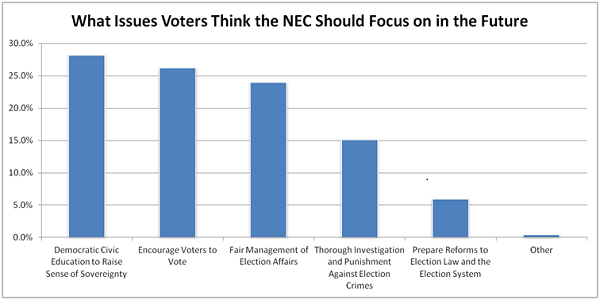
When asked what issues the NEC should focus on in the future, the most common answer with 28.2% was ‘democratic civic education to raise sense of sovereignty’ and the next most common answers were ‘encourage voters to vote’ (26.2%) and ‘fair management of election affairs’ (24%).
The survey was done by KSTAT Research ltd as commissioned by the NEC and surveyed 1,500 voters aged 19 and over nationwide from June 18 to July 6 using the ‘Tablet Assisted Personal Interviewing (TAPI)’ process. The sampling error was over/under 2.5% at a 95% confidence level and the sample was chosen by a proportional allocation method according to the sex, age, and residence of the population as of May 2018.
|
Graph%201.png "(1)Graph%201.png")
Graph%202.png "(1)Graph%202.png")
Graph%203.png "(1)Graph%203.png")
Graph%204.png "(2)Graph%204.png")
Graph%205.png "(1)Graph%205.png")
Graph%206.png "(2)Graph%206.png")

44 Hongchonmal-ro, Gwacheon-si, Gyeonggi-do 13809, Republic of Korea / Telephone: +82-2-503-0883 / E-mail: necvote@nec.go.kr
Copyright(c) National Election Commission. All Rights Reserved.