
News
Press Releases
HOME News Press Releases
| Results of an Analysis on Voter Turnout During the 20th National Assembly Elections Made Public |
|---|
|
Date :08/01/2016Read : 322 |
|
Results of an Analysis on Voter Turnout During the 20th National Assembly Elections’ Made Public = Analysis by gender, age group and region includes early voting and overseas voting =
The National Election Commission (NEC) of the Republic of Korea published the results of an analysis on voter turnout during the 20th National Assembly elections.
The analysis of voter turnout was conducted taking a systematic random sampling from the voters’ list targeting 4,365,307 voters (10.4 percent of the electorate) from 1,448 out of the 13,777 voting precinct nationwide. The analysis into early and overseas (absentee voters and permanent overseas voters) turnouts targeted the entire voters. The turnout found in the survey sample, which was 58.1 percent, was very close to actual voter turnout, which was 58 percent.
Voter turnout analysis by gender, age group and region are as follows:
Overall voting Voter turnout by gender
Turnout among males was 58.8 percent and among women was 57.4 percent, showing that male participation was 1.4 percent higher than the female voter turnout. Except for the 18th Presidential elections in 2012 which saw the turnout for women 1.6 percent higher than that of males, since the 16th Presidential elections in 2002 mostly male turnout has been higher than female turnout.
Compared with the 19th National Assembly elections, the increase in voter turnout for women was significantly more for women (up from 53.1 percent to 57.4 percent, a 4.3 percent increase) than for men (up from 55.7% percent to 58.8 percent, a 3.1 percent increase).
Voter turnout by age group
It was found that people in their 50’s, 60’s and 70’s all had voter turnout higher than the overall rate, but the voter turnouts those under 40 and over 80 were below the overall rate. The age group with the highest voter turnout was those in their 70’s, who recorded a rate of 73.3 percent, while the lowest group was those in their 80’s, 48.3 percent.
Voter%20Turnout%20by%20Age.png "(0)Voter%20Turnout%20by%20Age.png") The age range with the highest number of registered voters proportionally was those in their 40’s (21.0 percent), and the next largest group was those in their 50’s (19.8 percent). However, the highest age group proportionally that actually voted was those in their 50’s (20.8% percent), ahead of those in their 40’s (19.6 percent). Those aged between 50 and 70 made up a higher percentage of those that actually voted compared to their percentage of registered voters, proving that the elderly more actively participated in voting.
When comparing with the 19th National Assembly elections, there has been a significant increase in voter turnout of those in their 20’s and early 30’s (early 20’s up from 45.5 percent to 55.3 percent, late 20’s up from 37.9 percent to 49.8 percent, early 30’s up from 41.8 percent to 48.9 percent), however on the opposite side there has been a slight reduction in voter turnout among those in their 50’s (down from 62.4 percent to 60.8 percent).
Voter turnout by age group and gender
When looking at voter turnout by age and gender, for 19 year olds and for the age ranges from those in their late 20’s until those in their 40’s, the rate for women was higher, but for those in their early 20’s and age ranges of those in their 50’s and above the rate was higher for men.
In the case of men, those in their 60’s (74.5 percent) and 70’s (79.7%) had a very high turnout compared to the overall rate, while those in their late 20’s (47.3 percent) and early 30’s (47.2 percent) had a relatively low turnout.
In the case of women, as expected those in their 60’s (69.0 percent) and 70’s (68.4 percent) has a high turnout rate, while those in their late 20’s (52.6 percent) and early 30’s (50.7 percent) had a relatively low turnout.
When comparing with the 19th National Assembly elections, males in their late 20’s (up from 36.3 percent to 47.3 percent) and women in their early (up from 40.4 percent to 54.2 percent) and late 20’s (up from 39.5 percent to 52.6 percent) showed the most significant increase in turnout, meanwhile a decrease was seen in both men and women in their 50’s.
Voter turnout by region
There was very little difference between the voter turnout of the eight Sis (special cities larger than regular cities, overall 58.1 percent) and the nine Dos (provinces, overall 58.0%).
Among nine Sis, Seoul metropolitan city and special eight Sis, Sejong (63.5 percent), Gwangju (61.6 percent) and Seoul (59.8 percent) showed the highest turnout, while Daegu (54.8 percent), Busan (55.4 percent) and Incheon (55.6 percent) showed the lowest. From among the Do, South Jeolla (63.7 percent) and North Jeolla (62.9 percent) showed the highest turnout, while North Gyeongsang (56.7 percent) and South Chungcheong (55.5 percent) had the lowest.
When comparing with the 19th National Assembly elections, all Si and Do except South Gyeongsang Do (down from 57.2 percent to 57.0 percent) showed an increase in voter turnout. In particular Gwangju Si (up from 52.7 percent to 61.6 percent), North Jeolla Do (up from 53.6 percent to 62.9 percent), South Jeolla Do (up from 56.7 percent to 63.7 percent) and Gyeonggi Do (up from 52.6 percent to 57.5 percent) showed the largest increases in voter turnout.
By the size of the administrative districts, the pattern was the same as the 19th National Assembly elections, with the voter turnout in Myeon (60.7 percent) regions the highest, and following regions showed highest turnouts in the order of Seoul metropolitan city (59.8 percent), small/medium cities (57.9%), other special cities (56.8 percent) and Eup (56.3 percent).
Voter turnout by gender and region
When looking at voter turnout by gender and region, except for Daegu (male turnout 54.3 percent, female turnout 55.0 percent), all other regions showed a higher male turnout than women, in particular in Gangwon Do (4.1 percent) and Jeju Do (3.8 percent), the difference was the large.
The largest turnout for both men and women was in the order of South Jeolla Do (65.1 percent and 62.7 percent), North Jeolla Do (64.6 percent and 62.3 percent) and Sejong Si (63.3 percent and 60.9 percent), while the lowest turnout for men was in Daegu Si (54.3 percent) and for women was in South Chungcheon Do (53.5 percent).
Early voting
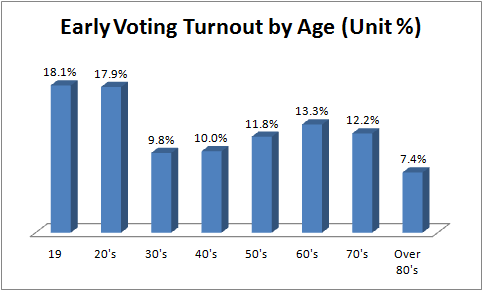
This is the first time early voting has been used in National Assembly elections, and the early voting turnout was 12.2 percent, with men (14.7 percent) showing higher than women (9.7 percent). By age group, the voting turnout among 19 year-olds (18.1 percent) and those in their 20’s (17.9 percent) was the highest, and except for 60 year olds (13.3 percent), all age groups from above those in their 30’s showed a lower rate than the overall early voter turnout.
In particular, in the case of those in their 20’s, the proportion of those in this age group made up of the total number of early voters (23.4 percent) was higher than their proportional number among the total amount of registered voters (15.8%), proving that they were the most active age group in participating in early voting.
By gender and age, the highest turnout of both men and women was in the 19 year old age group (21.6 percent and 14.3 percent) and those in their early 20’s (29.9 percent and 13.8 percent), but the lowest rates were in the late 30’s (10.4 percent and 8.3 percent) and 80 and over (10.4 percent and 6.1 percent) age groups. In particular, in the case of males, those serving in the military at the age of 19 or in their early 20’s had a relatively high early voting turnout.
By region, Do (12.8 percent) showed a larger early voting turnout than Si (larger than regular cities, 11.5 percent). Among Si larger than regular cities, Sejong (16.9 percent) and Gwangju (15.8 percent) had the highest rates, while Busan (9.8 percent) and Daegu (10.1 percent) has the lowest. In the case of Do, South Jeolla (18.9 percent) and North Jeolla (17.3 percent) had the highest, while Jeju (10.7 percent) and Gyeonggi (11.2 percent) has the lowest.
For both males and females, South Jeolla Do (21.5 percent and 16.3 percent) and North Jeolla Do (20.1 percent and 14.7 percent) had the highest turnout rates, while Busan Si (12.1 percent and 7.6 percent) and Daegu Si (12.5 percent and 7.8 percent) had the lowest.
Out of the total number of early voters, 33.9 percent voted outside their registered polling district. This was split into 31.9 percent who voted in polling districts in entirely different Gu/Si/Gun regions from their own, while 2 percent voted in the same Gu/Si/Gun region but a different polling district.
Overseas voting
For these National Assembly elections, 41.4 percent of registered overseas voters participated, and the turnout was higher among men (43.6 percent) than women (38.9 percent).
From among the age groups, those in their early 30’s (49.7 percent), late 20’s (46.8 percent) and late 30’s (46.3 percent) showed the highest turnout rates in the mentioned order, while those 80 and over (23.0 percent) showed the lowest. 19 year olds and those above 40 had a voter turnout lower than the overall rate, and from the early 30’s age group, the older a voter gets, the voting rate gradually gets declined. |
| Next The NEC Calls for Fair Saenuri Intra-Party Elections, Including the Election for Party Leader |
| Before NEBDC to Host the 12th National University Debate Competition |

44 Hongchonmal-ro, Gwacheon-si, Gyeonggi-do 13809, Republic of Korea / Telephone: +82-2-503-0883 / E-mail: necvote@nec.go.kr
Copyright(c) National Election Commission. All Rights Reserved.